Lanyon's sealed instruction
Lanyon's sealed instruction is a crucial piece of evidence in the mystery surrounding Dr. Henry Jekyll, a document that Dr. Hastie Lanyon prepares in the final weeks of his life and entrusts to Mr. Utterson. It is a physical embodiment of the secret that destroys Lanyon and a narrative key that Utterson is forbidden to use until the moment of Jekyll's death or disappearance. The instruction functions as both a confession and a warning, its very existence a testament to the horror that Lanyon witnessed and could not survive.
Origin and Condition
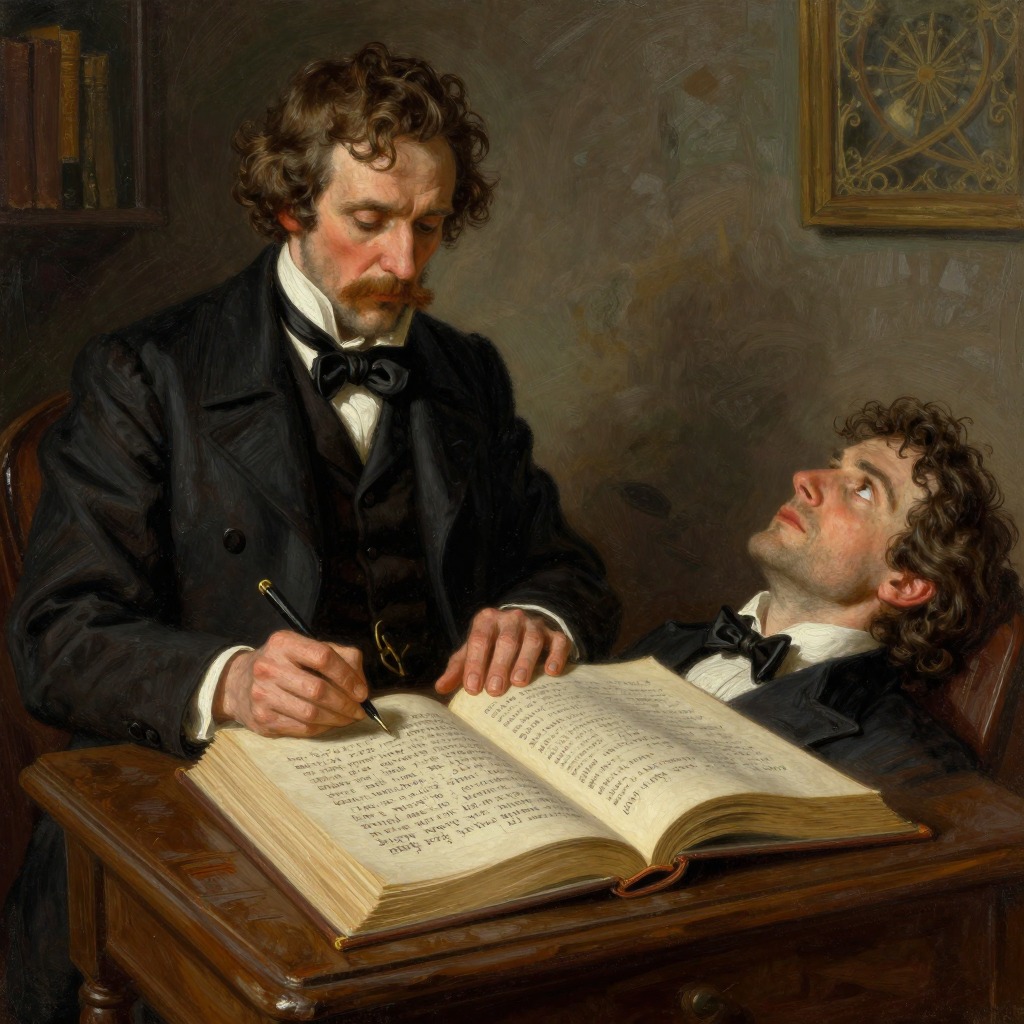
The instruction originates in the aftermath of a traumatic event. On the night of January 9th, Lanyon, at Jekyll's desperate request, retrieves a drawer from Jekyll's cabinet and later receives a visitor who, in his consulting room, drinks a potion and transforms from Edward Hyde into Henry Jekyll before his eyes. The shock of this revelation, which Lanyon describes as shaking his life "to its roots," leads to his rapid physical and mental decline. He tells Utterson that he has "had a shock" and will "never recover," declaring himself a "doomed man" within weeks. In the days following this encounter, Lanyon prepares the sealed instruction. He writes it by hand, seals it with his own seal, and addresses it to Utterson alone, with the emphatic superscription: "PRIVATE: for the hands of G. J. Utterson ALONE, and in case of his predecease to be destroyed unread." This condition underscores the gravity of the contents and Lanyon's desire to control the revelation of the secret.
Delivery and Utterson's Response
Lanyon dies in less than a fortnight after taking to his bed. The night after the funeral, a saddened Utterson locks himself in his business room and, by the light of a "melancholy candle," draws out the envelope. He dreads its contents, thinking, "I have buried one friend to-day: what if this should cost me another?" He condemns this fear as a disloyalty and breaks the seal. Inside, he finds another enclosure, also sealed, marked with the instruction: "not to be opened till the death or disappearance of Dr. Henry Jekyll." Utterson is amazed to see the word "disappearance" again, a term that had appeared in Jekyll's will, originally under the sinister influence of Hyde. The fact that Lanyon, a man of science and integrity, has written this condition fills Utterson with a "great curiosity" to disregard the prohibition and learn the truth immediately. However, his "professional honour and faith to his dead friend" are "stringent obligations," and he places the packet in the inmost corner of his private safe, unopened.
Contents and Significance
The sealed instruction contains Lanyon's own written narrative of the events of January 9th, which forms the ninth chapter of the book. In it, Lanyon describes receiving Jekyll's desperate letter, retrieving the drawer with its powders and phial, and the subsequent visit of Hyde. He recounts the transformation in vivid, horrified detail, concluding with the revelation that the creature who visited him was Hyde, the murderer of Sir Danvers Carew. The narrative is Lanyon's final act, a testament to a truth so terrible that it destroys his sanity and his life. It is a key piece of the puzzle that, when combined with Jekyll's own confession, finally explains the entire mystery to Utterson. The instruction's condition—that it be opened only upon Jekyll's death or disappearance—creates a narrative delay, forcing Utterson and the reader to wait until the final, catastrophic events of the story to learn the full truth. It is a structural device that heightens suspense and underscores the idea that some knowledge is too dangerous to be possessed before its time.